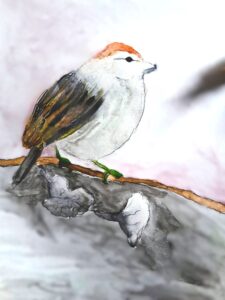
There was only one woodcock at Bryant Park today. He or she did not feel like dancing. The bird stared back at the row of cellular-phone photographers, eyes as black and shiny as a camera lens, head cocked slightly, beholding the beholders. “I know what makes me dance,” the lady bird thought. It wasn’t in the park this afternoon.
“All of these people here, and none of them have worms or seeds. None of them is a pretty woodcock boy whose dance would tell me everything I need to know. They are all like big birds holding smaller bird babies, some with two or three eyes, all facing forward.”
The real audience sits in the tables and chairs around the scene. Taking lunch, stopping by for a look at a tree, before running to catch a crowded train. They have seen the birds come and go, the fairweather watchers swell in size with the viral season before fully dissipating—a short-lived but ultimately harmless phenomenon, the spectacle of those who come to watch the dancing bird as it briefly stops in midtown.
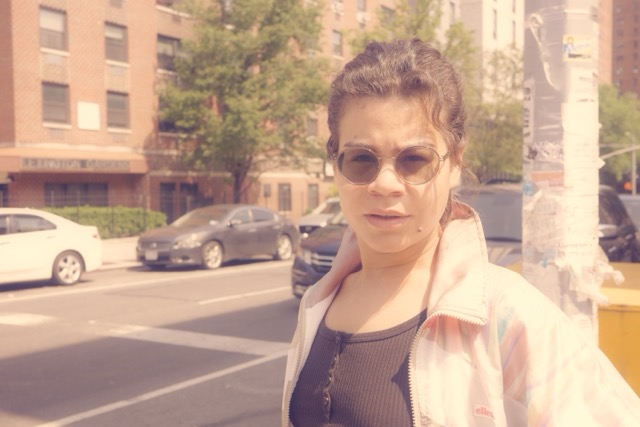
“They’re not dancing,” the woman next to me says to her friend. They are all pastel pinks and blues, heather beige and grey. In my black and white plumage, I add, “They’re camera shy.”
I knew where to find this bird because of the crowd. “It’s right there,” I say to my son, “but there’s only one.” A woman in black and white joins, and we exchange a quick disappointed smile.
Our reactions must be gentle and reserved, so as to not frighten the animal, who is already too aware of the many eyes on it. If they came here to forage, the task has been long forgotten. If they came here looking for a mate, there’s nothing of the sort in Bryant Park today. No one told them where all of the eligible bird mates would be this afternoon, and they didn’t know any better than to believe they would be cavorting out in the open in a crowded midtown park with hardly any trees in it. A monument to stone and iron, a human institution more than anything else. A big green lawn where only grass grew. My son gets to see this bird, and maybe we will go home and watch videos of it dancing on the train. But the woodcock will not perform for us.
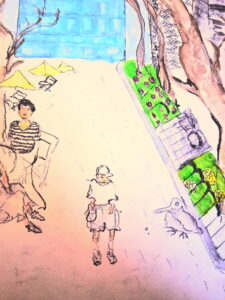
“There are many people here today,” thinks the child at her waist, eight years old this summer.
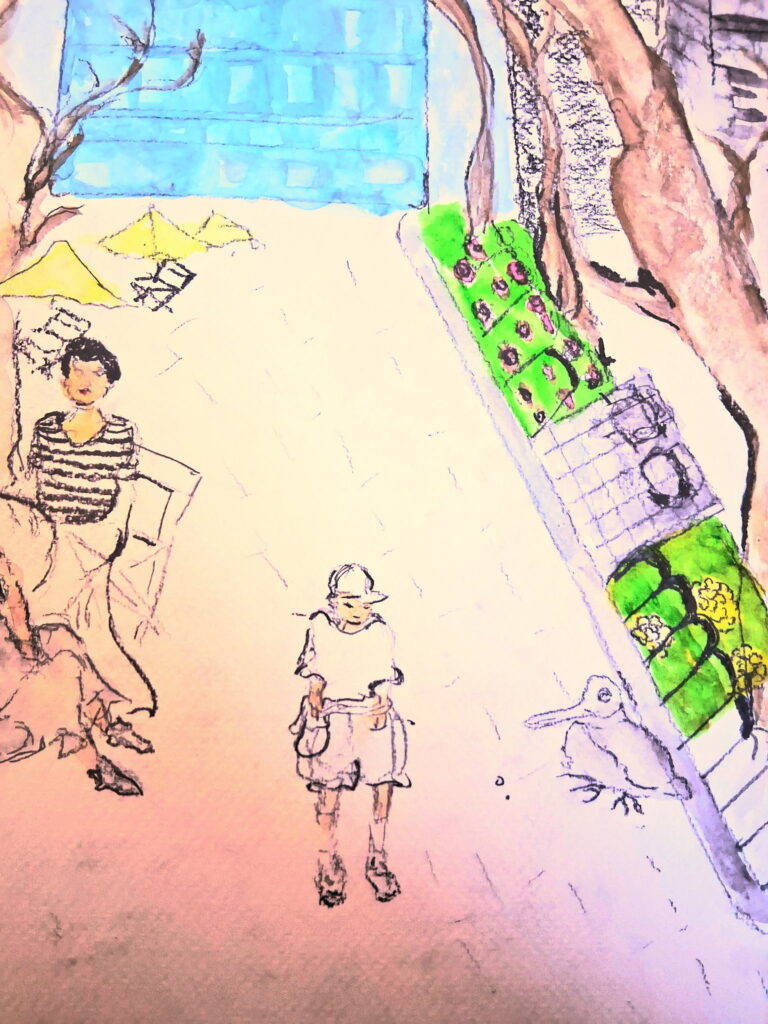
The boy knows that today is a good day because he gets to wear shorts and has to wear a baseball cap to keep the sun out of his eyes. “We didn’t even need an umbrella like mom said we would,” he thinks. “And all these people, grown adults, eating and talking outside in the middle of a Tuesday afternoon,” he reasons, “they must be on recess. This must be where all the big kids go when they’re allowed to be outside for lunch, when they can cross a street without holding a mommy or daddy’s hand. This is what it is to be free.”
The boy briefly regards the bird and supposes he likes it as much as anything else. The bird can fly away too if he wants, but stays back to watch. He can go and find his brothers and sisters and weave between the trees in limitless play, but on this sunny afternoon, he takes a quick rest to watch the birdwatchers. Maybe one of them was smart enough to bring a snack to share.
Heat begins to pool at the armpits of my linen shirt, thinks the woman in black and white. I remember how my parakeets used to air out their bodies, holding their folded wings angled away from themselves. They would yawn really big when it got dark, too. I did not like to see them caged after a while. They had family on another continent where blue and green and yellow and white plumage always darted through the sky. Their relatives were in Australia, but they were born in captivity. I saw fear and sadness in their round black eyes, and knew we shared a desire for a freedom we had never known, could not name, and might never.
The woodcock had none of that, as far as I could see. She would not perform for the spectators, but she was not imprisoned. She watched them back with an expectant expression as though any moment things might become interesting. Such is the nervous system of an animal of prey, vigilant and prepared to flee at the slightest infraction.
It was getting to be 4 pm; I started to think about heading to the next thing, but also about the bathroom urges humans must settle in privacy and the food now illegal to forage, and so I packed myself into a series of increasingly crowded trains, like a small fish with soft and edible bones, one in a sea of endless schools so massive and elaborate that I lost my own place in the great migratory plan and was making it up as I went along.